
 Español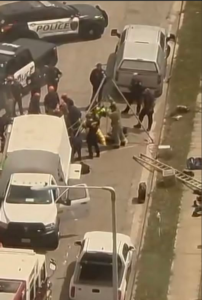
Downtown Corpus Christi Utility Worker Passed Away in Manhole Incident, Power Cut to Protect Crews
A 53-year-old utility worker named Lee Wane passed away Tuesday morning after an incident inside a manhole in downtown Corpus Christi, near the 600 block of Mestina Street, just steps from the Corpus Christi Cathedral. It’s an area people pass through every day, offices, government buildings, foot traffic, without ever thinking about what’s beneath it. Just below the surface is the infrastructure that keeps the city running.
Emergency crews were dispatched around 11:30 a.m. to what was initially reported as an electrical issue. Within minutes, it became clear this was something far more serious. Firefighters and first responders arrived to find a worker down inside a manhole roughly 10 feet underground, in a confined space where access is limited and every second matters. The response shifted immediately from routine to urgent. Crews worked to reach him, navigating the tight vertical entry and the hazards of underground electrical systems, but despite their efforts, the worker did not survive.
For the people on scene, this wasn’t abstract. It was immediate. It was physical. It was someone’s coworker, someone’s employee, someone’s family member, right there, in a place most people never even think about.
Corpus Christi Power Outage: Why Electricity Was Shut Off Across Downtown
Then, as crews responded, power was intentionally shut down across multiple parts of the city. That decision was critical for safety. Electrical systems, especially those carrying high voltage and electrical load (watts), cannot be safely approached during an emergency if there is any chance they remain energized.
More than 5,000 residents were left without electricity, affecting:
- Downtown
- Bayfront-adjacent areas
- Multiple outage clusters
Critical services impacted included:
- The Corpus Christi Police Department
- The Nueces County Courthouse
- Telecommunications infrastructure
- Local businesses and offices
It is being reported that power was not fully restored until approximately 11:20 p.m.
AEP Confirms Fatal Incident; Public Response
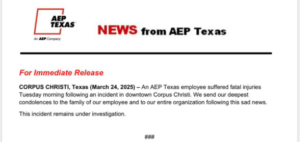
As more information came out, AEP Texas confirmed that the worker involved was one of its employees, stating that he “suffered fatal injuries Tuesday morning following an incident in downtown Corpus Christi.” The company said the incident remains under investigation and expressed condolences to the worker’s family, coworkers, and everyone affected.
For those who work in and around this kind of infrastructure, the loss hits close to home. These are not abstract risks, they are part of the job, every day, often out of public view. The incident has also drawn a response from state leadership. State Senator Adam Hinojosa said:
“This is a devastating reminder of the risks so many take every day to keep our communities powered and running. Please join me in praying for the employee’s family, loved ones, and coworkers during this incredibly difficult time.”
Electrocution Risks and Arc Flash Dangers in Underground Electrical Work
To understand how something like this can happen, electrical infrastructure work involves real exposure to electrocution hazards—not theoretical risks, but conditions that can become deadly in an instant.
One of the most dangerous events in this type of work is an arc flash. An arc flash is a sudden release of electrical energy caused when current jumps through the air between conductors or to ground. It happens in fractions of a second, but the effects are immediate and severe.
An arc flash can:
- Reach temperatures hotter than the surface of the sun
- Create a powerful pressure wave capable of knocking a person off their feet
- Produce intense light and sound that can disorient or incapacitate
- Cause severe burns or fatal injuries almost instantly
This is not just heat, it is a violent event. Workers can be exposed to both thermal energy and blast force at the same time. In an open environment, those risks are already significant. Inside a confined underground vault, they are amplified. There is no room to step back. No space to escape. The walls reflect heat and pressure back toward the worker. Equipment is close, lines are often within arm’s reach, and visibility can already be limited before anything goes wrong.
Even something as simple as turning equipment on or off, what’s known as energization or de-energization, has to be done carefully. Workers are trained to perform checks like “live–dead–live” testing to confirm whether a system is energized. If that process fails, or if a system behaves unexpectedly, the worker can be exposed without warning.
In these environments, the difference between a normal workday and a fatal incident can come down to a single moment—a single misread, a single unexpected condition, or a single breakdown in safety procedures. That is why electrical work at this level is treated with such precision and caution. The danger is not just present—it is constant.

PPE, Arc Ratings, and Why Electrical Safety Gear Matters
Because of those risks, when people think of safety gear, they usually picture hard hats and gloves. However, that would be incorrect. In high-voltage electrical work, especially in underground vaults, workers rely on arc-rated personal protective equipment (PPE) designed specifically for one of the worst-case scenarios: an arc flash. OSHA explains that employers have to match protective clothing and equipment to the estimated heat energy exposure, measured in calories per square centimeter (cal/cm²).
Utility workers rely on arc-rated PPE designed to withstand that energy, including:
- Arc-rated clothing
- Voltage-rated gloves
- Face shields and arc hoods
- Flash suits
What most people do not realize is that this equipment is not one-size-fits-all. Each piece carries an arc rating, measured in cal/cm²—a technical way of describing how much thermal energy the material can absorb before it fails. Higher voltage systems can mean greater potential energy, and greater potential energy requires higher-rated protection. That is why the gear has to be matched to the actual hazard, not just thrown on as a general precaution.
There is also a recognized PPE category system used in electrical safety work. NFPA 70E’s table sets out categories 1 through 4, with minimum arc-rated clothing levels of:
- Category 1: 4 cal/cm² minimum
- Category 2: 8 cal/cm² minimum
- Category 3: 25 cal/cm² minimum
- Category 4: 40 cal/cm² minimum
For readers who are not familiar with this industry, that matters because the difference between an 8 cal/cm² gear and a 40 cal/cm² gear is not minor. It reflects a very different level of potential energy exposure and a very different level of danger. OSHA also notes that the arc-flash boundary is based on exposure at 1.2 cal/cm², the threshold for the possibility of a second-degree burn to unprotected skin.
Before work begins, the hazard is supposed to be evaluated so the worker is wearing PPE rated for the conditions they are about to face. Because if the energy released exceeds the rating of the PPE, the protection can fail. This gear is not optional. It is not just precautionary. It is the last line of defense between a worker and a catastrophic injury. Even when everything is done correctly, the environment itself—tight spaces, limited escape, and proximity to energized systems—means the margin for error is extremely small.
Safety Procedures: Lockout/Tagout and “Live–Dead–Live”
Along with protective equipment, to reduce the risk of electrocution, workers follow strict, step-by-step procedures designed to eliminate uncertainty before any work begins. Two of the most critical are Lockout/Tagout (LOTO) and “Live–Dead–Live” testing.
- Lockout/Tagout (LOTO): This process ensures that electrical systems are not just turned off—but physically secured so they cannot be turned back on while work is being performed. That typically involves isolating the energy source, placing a lock on the disconnect, and attaching a tag identifying who locked it out and why. The key point is control: only the person who placed the lock should be able to remove it. This prevents accidental or unauthorized re-energization while someone is working on the system.
- Live–Dead–Live Testing: This is a verification step that confirms whether equipment is actually de-energized. The worker first tests a known live source to confirm the tester is working (“live”), then tests the equipment in question (“dead”), and finally tests the live source again (“live”) to ensure the tester didn’t fail during the process. It is a simple concept, but it removes guesswork from a situation where guessing can be fatal.
These procedures exist because electrical systems do not always behave the way people expect. Power can be fed from multiple sources. Circuits can be mislabeled. Equipment can remain energized even when it appears to be off. Induced or stored energy can still be present in the system. In other words, “off” is not always off. That is why these steps are treated as mandatory, not optional. They are designed to remove assumptions and replace them with verification. A single incorrect assumption about whether a line is energized, whether a breaker is open or whether a system is safe, can result in immediate and irreversible consequences.
Questions Being Raised About Safety Conditions Inside the Vault
In light of those risks and procedures, in the aftermath of the incident, people familiar with underground electrical work have been asking the same kinds of questions:
- Was there a hole watch or attendant outside the manhole?
- Was the worker wearing the required PPE for the hazard level involved?
- Was a tripod or other rescue setup in place?
- Were multiple linemen assigned to the vault, or was the worker alone?
- Was there another qualified worker or apprentice nearby to respond immediately if something went wrong?
- Was the system fully de-energized before work began?
- Were Lockout/Tagout (LOTO) procedures properly implemented and verified?
- Was “Live–Dead–Live” testing performed to confirm the system was not energized?
- Were there multiple possible energy sources feeding the system, and were all of them accounted for?
- Was the vault inspected for water intrusion or standing water before entry?
- Was the worker in communication with personnel above ground at all times?
- Was there a confined space entry permit or procedure in place for the work being performed?
- Were proper grounding procedures used to eliminate residual or induced energy?
- Was the equipment or insulation in the vault known to be degraded or compromised?
- Were hazard assessments conducted to determine the appropriate arc-flash boundary and PPE level?
- Was the work being performed on or near energized equipment when it could have been de-energized?
- Were all crew members properly trained and briefed on the specific hazards of that vault?
These are important questions because this type of work is not ordinary electrical work. Much of downtown Corpus Christi’s electrical infrastructure does not run overhead. It runs underground through a network of utility vaults, accessed by manholes like the one involved in this incident. These vaults sit beneath streets, sidewalks, government buildings, churches, and offices, largely unseen, but critical to how power is distributed across downtown and surrounding areas.
Inside, these spaces can contain high-voltage lines, transformers, switches, and splices, often within arm’s reach in a confined environment. In a coastal city like Corpus Christi, water intrusion also poses another challenge. Many of these vaults have to be monitored and pumped out regularly due to the water table and flooding conditions. When water enters the system, it does not just create inconvenience, it can increase conductivity, accelerate insulation breakdown over time, and introduce additional unpredictability into already dangerous electrical conditions.
Even where conductors are insulated, that insulation is not permanent. Heat, age, and moisture, especially saltwater exposure, can degrade it. When that happens, the risk is not limited to outages. It can create the conditions for phase-to-phase faults, phase-to-ground events, arc flashes, and electrocution.
OSHA recognizes manholes and underground vaults as confined or enclosed spaces, and safety rules for that kind of work focus heavily on hazard recognition, communication, attendants, and rescue readiness. That matters because when an electrical event occurs underground, the worker inside may have little chance to save himself. A shock or arc event can happen instantly. A worker may lose consciousness before calling for help. He may be unable to climb out. In a vertical-entry manhole, even a short delay in response can be catastrophic. That is one reason trained backup personnel are so important in high-risk electrical work, not as a formality, but as an immediate lifeline if conditions suddenly turn critical.
So when people ask whether this could have been avoided, or whether the chances could at least have been reduced, they are really asking whether every safety layer was in place before the work began: proper hazard assessment, proper PPE, proper staffing, proper monitoring, proper rescue preparation, and proper control of the electrical environment. That is the kind of scrutiny an incident like this deserves.
Putting This in Perspective: Electrocution and Electrical Deaths in Texas and the U.S.
While this incident feels isolated, what happened here feels rare. Unfortunately though, electrical fatalities are a known and recurring part of this type of work. According to the Electrical Safety Foundation International:
- Approximately 150 workers die each year in the U.S. from electrical incidents
- Electrical exposure accounts for thousands of serious injuries annually
- Over the past decade, more than 2,000 workplace deaths have been tied to electricity
That means, on average, someone dies from an electrical incident every few days. The U.S. Bureau of Labor Statistics consistently ranks electrical and power-line work among the most dangerous occupations:
- Electrical power-line workers have fatality rates far above the national average
- These jobs routinely involve exposure to high voltage systems, energized lines, and confined environments
In Texas, the scale is even larger. With one of the biggest energy infrastructures in the country, including transmission lines, substations, and underground systems, thousands of workers are involved in electrical distribution and maintenance across the state every day. These incidents are even more prevalent in environments where:
- The hazards are known
- The systems are complex
- And the consequences of a mistake can be immediate
Electrical Contractors and Infrastructure Work in South Texas
Importantly, work like this does not happen in a vacuum. Electrical infrastructure projects, especially those involving underground distribution systems, are often performed by a mix of utility providers, contractors, and specialized crews. In South Texas, that can include companies working on behalf of utilities, as well as third-party electrical contractors handling maintenance, upgrades, or emergency response.
What matters is not just who was present, but how the work was being coordinated. Jobs involving high voltage systems and confined spaces require:
- Clear supervision
- Defined roles between crews
- Communication across all workers on site
- A shared understanding of whether systems are energized or de-energized
When multiple groups are involved, those responsibilities can overlap. When they do, even small breakdowns in communication or coordination can have serious consequences. That is why these types of incidents are examined closely, because understanding how the work was structured is often key to understanding what happened and how to prevent similar incidents in the future.
When Answers Matter: Corpus Christi Electrocution and Wrongful Death Cases
When incidents like this happen, families are left asking:
- What caused the electrocution or electrical failure?
- Were proper safety procedures followed?
- Could it have been prevented?
Those answers matter. At Perkins & Perkins, we handle serious injury and wrongful death cases involving electrocution, industrial accidents, and electrical infrastructure failures throughout Texas. We recently obtained an $18.1 million jury verdict for our client, who was injured on the job, which was recognized as the largest workplace injury verdict in Texas that year.
If you have questions about an electrical incident in Texas, getting accurate information early can make a serious difference. Evidence can disappear, conditions can change, and the window to preserve key facts is often short. We offer free, no-obligation consultations, and you pay nothing unless we recover for you. That means no upfront costs, no hourly fees, and no financial risk. You don’t have to handle this on your own, call us today at 361-853-2120, or visit us online at Perkinsperkinslaw.com.
We extend our condolences to the Lee Wayne’s family, loved ones, and coworkers. Our thoughts and prayers are with those affected.
Disclaimer
This article is for informational purposes only and is not legal advice. Reading this content does not create an attorney-client relationship. Every case is different, and outcomes depend on the specific facts and applicable law. If you have questions about a potential claim, you should consult with an attorney regarding your specific situation.